Blend-in decisions
Paint Hide and Seek searches often come from players who saw a game where you paint yourself to match walls, props, floors, or rooms. The first need is knowing how color, angle, and movement reveal a hider.
Independent Paint Hide and Seek Guide
Use this Paint Hide and Seek guide to understand the fast-growing color camouflage game trend: how to paint yourself into the background, choose better hiding spots, read seeker routes, and find official places to play without unsafe download claims.
Search intent
Paint Hide and Seek searches often come from players who saw a game where you paint yourself to match walls, props, floors, or rooms. The first need is knowing how color, angle, and movement reveal a hider.
Good hiding is not only color matching. Players need Paint Hide and Seek map habits: avoid obvious corners, rotate after scans, and understand where seekers naturally sweep first.
Seekers need a different guide: look for mismatched paint edges, repeated body shapes, panic movement, shadow changes, and places that feel too clean or too symmetrical.
Players also search Roblox, SPLATTER, PAINT or DIE, and Steam-style paint hide and seek games. This site points to official sources and does not invent a fake playable iframe.
Beginner route
The biggest Paint Hide and Seek mistake is painting first and then looking for a wall that fits. Choose the surface first. Look for a large, flat color area with broken visual noise nearby, then paint yourself to that area instead of chasing a flashy color in the open.
A hider can have the right blue, green, or red and still stand out because the brightness is wrong. In Paint Hide and Seek, darker corners, patterned floors, and shaded walls hide shape better than perfect but flat color matches in bright rooms.
Seekers often find players by silhouette. Crouch, rotate, or tuck beside props if the game allows it. Avoid standing against a single-color wall where your head, backpack, arms, or tool shape creates a clean outline.
Movement is louder than color. Wait until the seeker is checking another lane, a nearby prop cluster, or a far wall before rotating. Small late movement is usually safer than early panic movement.
Do not only stare at the center of a room. Sweep corners, object edges, door frames, ladders, stairs, and color transitions. In most Paint Hide and Seek games, hidden players fail at the boundary between their painted body and the surface behind them.
Guide architecture
Hider pages should explain how to read rooms, choose colors, break outlines, and decide when to rotate.
Seeker pages should help players inspect spaces methodically instead of guessing randomly.
Platform pages should separate Roblox experiences, Steam games, and video trends so users can find the right official source.
Game tool opportunity scan
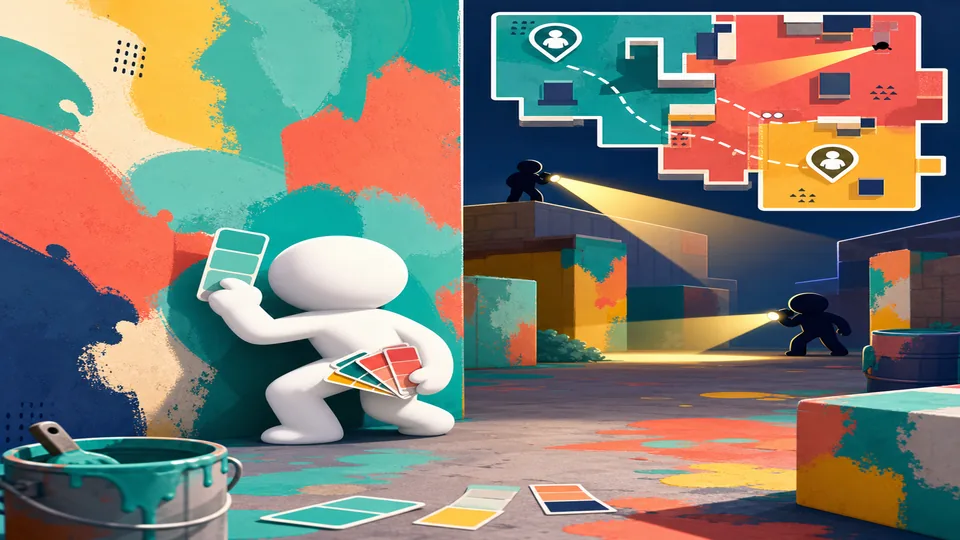
The loop is simple: hiders paint or camouflage themselves, seekers inspect the map, and both sides manage timing. That creates strong strategy content but weak calculator demand because public match values, damage numbers, trade values, and upgrade costs are not the center of play.
Players repeatedly decide which surface to copy, whether a hiding angle exposes their outline, when to rotate, and which room path a seeker should scan first. Those decisions are best served by checklists, examples, and map guides.
A future lightweight map checklist or hiding-spot rating tool could help once verified maps and screenshots are available. For now, this homepage avoids fake math and keeps the Paint Hide and Seek advice transparent.
Because multiple games use similar paint hide and seek wording, the site treats Roblox and Steam mentions as related discovery paths. It links to official search or store sources rather than pretending one unofficial download is definitive.
Official sources
Paint Hide and Seek is a descriptive search phrase, not always one single official title. Some users mean Roblox paint camouflage experiences such as SPLATTER or PAINT or DIE-style rounds, while others mean PC party games like MECCHA CHAMELEON. Use official Roblox or Steam pages, verify the exact title, and avoid mirror downloads that promise free clients or cheats.
Paint Hide and Seek is becoming a recognizable search pattern because players are trying to name a very specific kind of game: a hide-and-seek round where the hider paints themselves, copies a wall color, blends into a prop area, or uses camouflage to fool the seeker. Some players discover it through Roblox videos and searches for SPLATTER, PAINT or DIE, or a hide and seek game where you paint yourself. Others connect the phrase with PC and Steam games that use a similar color-matching hiding fantasy. This Paint Hide and Seek homepage is designed for that mixed intent. It gives players immediate strategy, explains the difference between hider and seeker decisions, and points users toward official play sources without claiming that this site hosts the game.
A related search pattern is paint and hide or hide and seek paint. Those phrases can mean a real paint-camouflage game, a Roblox round, a Steam party game, or even unrelated craft content such as hide-and-seek painting kits. On this site, the phrase belongs only to game strategy when the user intent is hiding as a painted player, matching a wall color, or seeking painted hiders. Craft or rock-painting meanings are deliberately left out because they would not fit the current page.
Players also search for what platform Paint Hide and Seek is on, whether it is free, and whether a Steam download exists. The phrase can describe several games, not one universal product. Confirm the exact title, then use its official Roblox page, Steam listing, or developer site for current platform, price, release status, and installation details. Avoid third-party APKs and repacks.
The first thing to understand about Paint Hide and Seek is that the best hiding spot is rarely the prettiest one. A bright wall can feel tempting because the paint match looks obvious, but seekers learn to check large flat surfaces first. Better hiding usually combines color, brightness, shape, and timing. If the map has a cluttered shelf, a painted corner, a shadowed hallway, or a wall with repeated objects, those areas can hide a player outline more effectively than a perfect color patch in the middle of an empty room. A good Paint Hide and Seek guide therefore needs to teach visual judgment, not only list spots.
For hiders, the strongest rule is to choose a surface before committing to a paint color. In many paint hide and seek games, beginners grab a color and then wander around trying to justify it. That wastes time and creates movement trails that seekers notice. A stronger route is to enter the room, identify two or three possible backgrounds, pick the one with the best cover and escape route, then match your paint to that surface. If the game allows crouching, leaning, or hiding beside props, use those mechanics to break the silhouette. If it does not, use wall edges, stairs, columns, or darker patches to make your body less readable.
For seekers, Paint Hide and Seek is a pattern-recognition game. Randomly running through rooms can work against weak hiders, but it fails when players understand color camouflage. Start each room with the borders: corners, door frames, stair edges, object clusters, and places where two colors meet. Look for a slightly wrong brightness, a repeated shape that does not belong, a player-sized curve on a flat wall, or a tiny movement after you turn away. If there are multiple seekers, divide rooms into lanes instead of stacking everyone on the same obvious spot. A clean sweep beats a dramatic chase when the hider is patient.
Search data also shows that many users do not know the exact game name. Queries like hide and seek game where you paint yourself, paint hide and seek Roblox, paint or die hide and seek, and hide and seek game Steam can point to different experiences. That is why this site avoids a single fake download button. The official-source section links to Roblox and Steam search pages so players can verify the title they actually want. If a future page covers a specific Roblox experience or Steam title, it should cite the official game page, developer source, or store listing and keep exact release, price, and platform facts tied to that source.
The tool opportunity scan for Paint Hide and Seek is intentionally conservative. Roblox games with trading, upgrades, pets, currencies, or DPS values often deserve calculators and value checkers. Paint Hide and Seek does not currently have a reliable public numerical layer that would make a calculator useful on the homepage. A fake hiding-score tool would look interactive but would not solve the user problem honestly. The better homepage experience is a structured guide: hider principles, seeker checklist, map habits, official play guidance, and FAQ. Later, if verified maps become available, a hiding-spot checklist or route planner could become a useful tool page.
A complete Paint Hide and Seek wiki should eventually split this homepage into deeper pages. A Roblox page could explain how to find official Paint Hide and Seek-style experiences, what to check before joining, and why unofficial download links are risky. A hider guide could compare wall hiding, floor hiding, prop blending, last-second rotations, and bait spots. A seeker guide could cover sweep routes, team communication, time management, and common camouflage failures. A video page could curate official trailers or safe gameplay previews when permission and source quality are clear. The homepage keeps these as planned clusters for now so the site does not publish thin pages before they can be useful.
The main Paint Hide and Seek skill is patience. Hiders lose when they overcorrect every time a seeker turns their head. Seekers lose when they chase every suspicious pixel without finishing the room. The best players use the round timer. If you are hiding, survive the early scan with a believable color match, then move only when the seeker commits to a different lane. If you are seeking, do not let one tricky corner consume the whole round. Mark it mentally, clear the rest of the room, then return when the hider expects you to have moved on. This rhythm matters more than memorizing one secret spot from a short video.
For traditional search and AI search, this page keeps the core Paint Hide and Seek answer in crawlable text. The H1 names Paint Hide and Seek directly, the first sections answer why players search for it, the beginner route gives practical tactics, and the FAQ covers Roblox, Steam, playing online, safety, and whether the site is official. The visual asset is an original editorial illustration, not a fake screenshot. That distinction is important because players should be able to trust whether an image shows real gameplay, a store source, or a guide concept. As the site grows, future updates should add real official media only when the source and usage are clear.
FAQ